Six pieces, eighteen robots6 original parts · 0 added
Six pieces, eighteen robots: the 1819 motion study
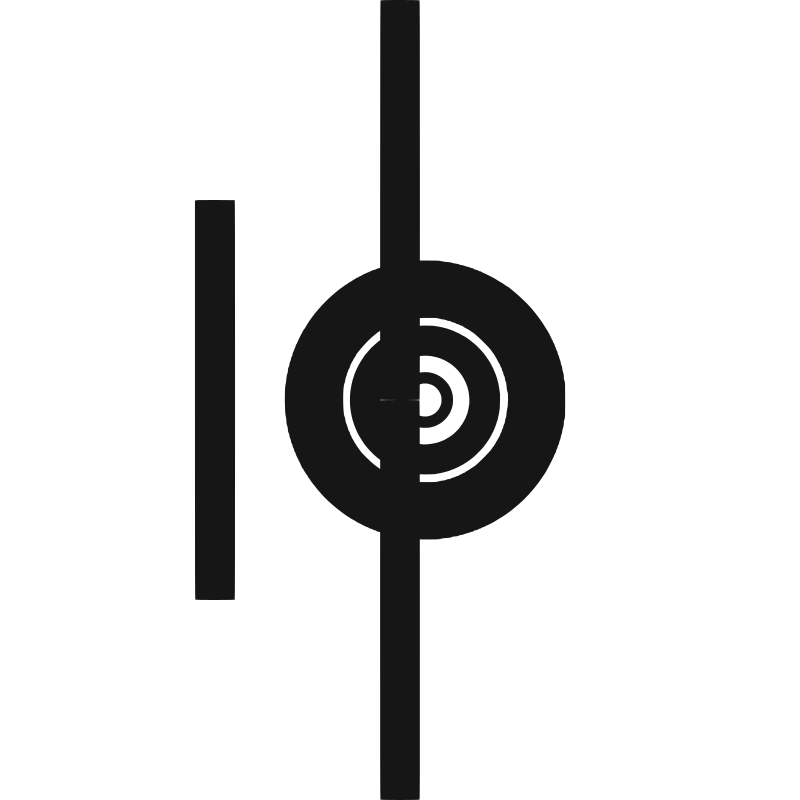
The 1819 mark contains exactly six vector pieces: three bars and three rings. With one rule, reuse every piece and add nothing, it became eighteen machines and a deterministic twelve-second motion study.
5 min read· Sep 5, 2026·Updated Sep 9, 20261 view
AIDesignSVGAnimation
The 1819 mark looks like a wordmark. It is actually a parts bin.
Open the artwork and count what is inside. Both 1s are bars, and so is the stem of the 9. The 8 contributes two stacked rings, and the 9 adds a third. Three bars, three rings, nine source contours. That is the entire inventory. There is nothing else in the file.
So I asked a constraint-flavored question: if the only parts I am allowed to use are the six pieces already inside the mark, and every composition has to use each piece exactly once, how many machines can it become?
Eighteen. And every one of them makes the same argument from a different angle.
The only allowed transforms are translation, rotation, and uniform scaling.
No added shapes, no duplicated parts, no wordmark.
No cutting a ring in half because a composition wants a semicircle. No borrowing a seventh part from another asset. If a design could not be solved with three bars, three rings, and three transforms, it did not ship.
The concepts cover the whole mechanical spectrum, and all eighteen are assembled and animated on the motion study page:
Pincer: two bars close as gripper jaws around a ring payload.
Strider: two rings drop to the floor as wheels under a bar chassis.
Gantry: the bars become an overhead rail and the rings ride it as carriages.
Dock: a landing pad with ring markers and bar approach lights.
Nexus: a multi-agent network where every part is a node.
Router: a branching junction that steers a token through its ring gates.
Vision: a machine-vision scanner with the three rings nested into a lens.
Pulse: a signal level meter with a ring gauge and a bar needle.
Spark: a lightbulb built from a ring glass and a bar screw base.
Launch: a rocket with ring fins around a bar fuselage.
Mono: a balancing cyclops riding a single ring wheel.
Orbit: a drone with ring rotors on a bar frame.
Maker: a workshop arm swinging on a ring pivot.
Tripod: a surveyor with three bar legs and a ring scope.
Echo: an expressive avatar with a ring face and bar antennas.
Scout: a biped walker with ring joints.
Rover: a wheeled explorer with a ring dome.
Signal: a compact robot face, all six parts shrunk to fit.
Some of these came out of the box finished. Others took a dozen attempts before the six pieces stopped fighting the concept. The constraint decides which ideas are even possible, which turns out to be the most useful filter an ideation process can have.
Hot or NotTap to vote
Six of the eighteen concepts from the motion study. Give each machine your verdict.
This is the same argument I made when I wrote about SVGs: an SVG is not a finished picture. It is a set of named parts with coordinates, fills, and relationships.
That is what makes a study like this possible at all. The 1819 artwork did not arrive as a flattened bitmap. It arrived as six identifiable pieces, which means a script can pick them up, rotate them, scale them, and reassemble them without a human ever redrawing a line.
The ideation loop became a conversation with the asset. Ask the file what it contains. Enumerate the legal transforms. Generate every composition that satisfies the rules. Reject the ones that do not read as anything. The designer's job moved from drawing machines to recognizing them.
Every concept plays as a deterministic twelve-second loop. No libraries, no random values, no timers. The same code that runs the QA harness renders the exported animated SVG, frame for frame.
Each frame also runs a geometry audit. The stage must contain exactly the six original paths, the nine source contours, and zero added elements. If an audit ever fails, the player throws instead of pretending. The HUD keeps the score visible the whole time: 6 original paths, 9 source contours, 0 added.
This is the honest part. AI-assisted work makes it easy to produce files that look finished, and the only cure I have found is an audit that can fail. It is the same lesson as the queso jar study: prompt, inspect, measure, reject, rebuild, validate. The magic is not the first render. The magic is staying in the loop until the render is telling the truth.
The 1819 Innovation Hub exists to turn ideas into working prototypes. So the study does not just decorate the mark. It turns the mark into the thing the hub stands for: a machine that assembles itself out of what already exists.
Robotics was the right lens for another reason too. Robots are systems of constraint. A gripper can only close so far, a wheel only rolls forward, a scanner only sees what is in frame. Designing eighteen of them from one parts list is a small rehearsal of real engineering: you rarely get new parts, you get better at arranging the ones you have.
Loose briefs produce safe ideas. The four rules of this study produced ideas I would never have volunteered without them, because the box did the eliminating for me. Every decision was forced, so every decision meant something.
The mark was always a parts bin. The constraint just made me look inside.
Concept study based on the supplied 1819 artwork. It is not an approved institutional identity.

 No more cheesy fingers: I gave the queso jar a twist-up baseA deodorant-stick-style idea for keeping dip at the rim - and what it took to turn a snack-time joke into an honest functional concept.